5/9/2026
This article is part of a series from Leveraging patterns. Here we cover pattern curation: influencing outputs by showing input/output examples the model should imitate.
What is it?
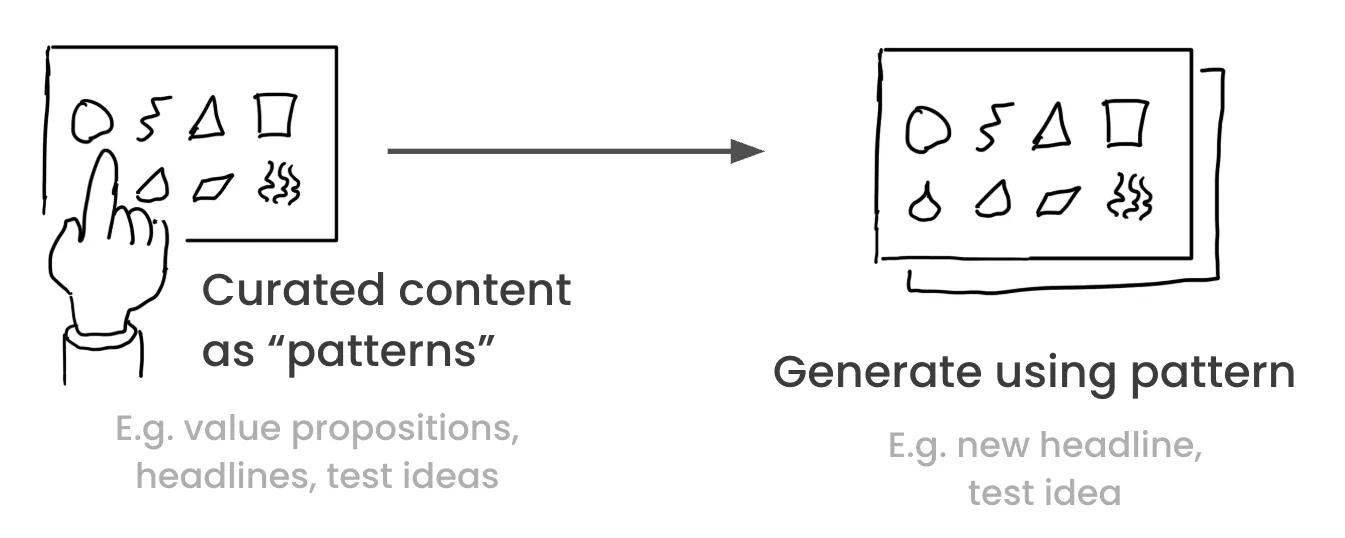
Pattern curation is where you use examples to influence or control the LLM’s attention for its output.
In terms of choosing those examples, three approaches show up most often:
-
Random sampling (“random few-shot”) — You pick demonstrations without tailoring them to each input (for example random draws from a labelled pool). It is a strong all-purpose baseline: low effort, often good enough when your pool is already on-task and representative.
-
Similar matches (“similarity-based”) — You retrieve examples that resemble the current input (often via embeddings). The model tends to follow structure and rules more tightly because the demonstrations sit close to the case at hand in meaning or surface form.
-
Human-curated — You hand-pick or refine examples (tone, edge cases, formatting). This costs the most effort but steers outputs toward your preferences: brand voice, policy, idiosyncratic labels, or outputs you do not trust similarity or random draws to preserve.
Why it works
LLMs are trained on patterns. You manipulate attention through examples—machine-learning intuition close to supervised learning. In prompting this shows up as few-shot prompting.
Examples of use
- Convergent thinking
- Brand voice: curated headlines or copy (upfront human effort) trains tone
- Email subject lines at scale
- Content ideation aligned with existing examples
- Structure: conform to a given shape (for example a table)
Usage example (1)
When you have input/output pairs—for instance labelling user feedback, or nudging the model to focus on one part of the content—repeat examples then finish with the real input.
%CONTEXT%
Some basic context

%TASK%
Your task

%LIST USER FEEDBACK%
Example list of feedback

%OUTPUT%
Example of labels

%LIST USER FEEDBACK%
Example list of feedback

%OUTPUT%
Example of labels

%LIST USER FEEDBACK%
Example list of feedback

%OUTPUT%
Example of labels

%LIST USER FEEDBACK%
Actual list of feedback

%OUTPUT%
Usage example (2)
When you have content only and want more content in the same vein:
%CONTEXT%
Some basic context

%LIST OF EXAMPLES%
Examples of some content (e.g. ideas/value prop messages/headlines)

%TASK%
Your task (e.g. give me headlines)
References
Studies and surveys that support why curated examples (few-shot / demonstration prompting) steer outputs:
- Brown et al., Language Models are Few-Shot Learners — central reference for few-shot task adaptation purely via context (the practice closest to “pattern curation” here).
- Reynolds & McDonell, Prompt Programming for Large Language Models — early systematic discussion of prompt design and conditioning behaviour without fine-tuning.
- Liu et al., What Makes Good In-Context Examples for GPT-3? — empirical work on example selection and what improves few-shot performance.
- Lu et al., Fantastically Ordered Prompts — shows order and pairing of demonstrations matter (calibration of pattern completion).
- Dong et al., A Survey on In-context Learning — broader survey tying together mechanisms and prompting variants built on in-context demonstration.
- Min et al., Rethinking the Role of Demonstrations — investigates what demonstrations actually provide (e.g. label space and distribution specification vs. pattern copying).
Also in this series